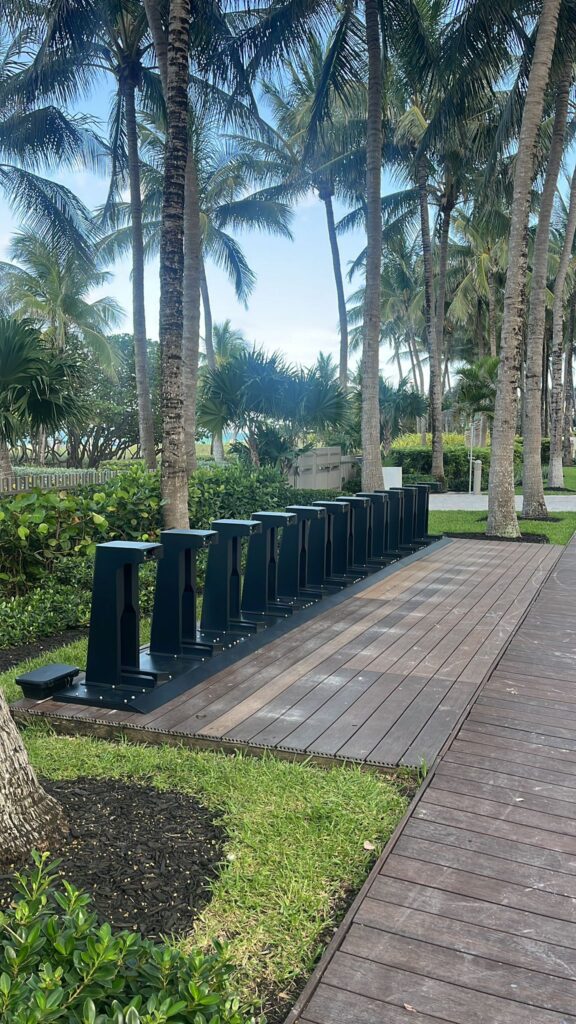
As shared electric bikes and scooters become an increasingly important part of urban mobility, operators need more than a convenient place to park their vehicles. They need an infrastructure solution that brings together secure parking, reliable charging, vehicle control, and efficient fleet management.
A charging dock is where these functions meet. Its mechanical structure, electrical connections, communication system, and environmental protection all influence how well it performs in daily operations.
So, what should operators and mobility companies look for when selecting a charging dock for a shared e-bike or e-scooter fleet?
1. A Charging Dock Must Be Designed for the Vehicle
One of the first things to understand is that a charging dock is not simply a charger mounted inside a metal enclosure.
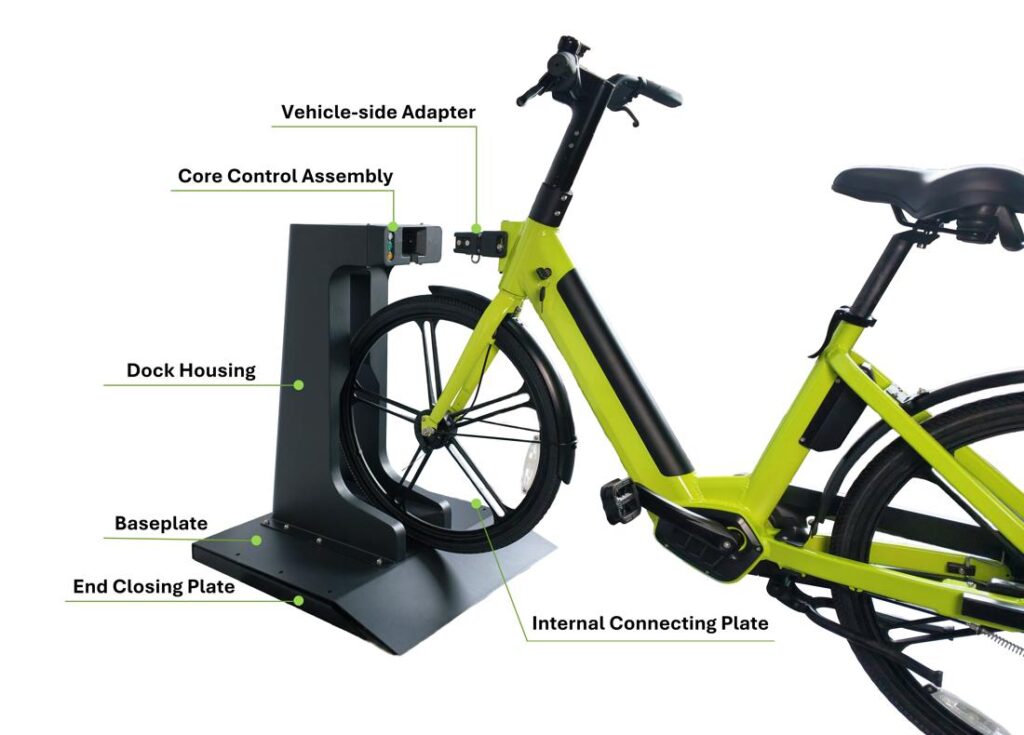
For a shared mobility application, the dock must fit the vehicle mechanically and work with its electrical and electronic systems.
The vehicle-side adapter needs to align correctly with the docking mechanism. The locking structure must engage reliably, and the charging and communication contacts must connect as intended.
Different vehicles may have different frame geometries, mounting positions, battery voltages, wiring arrangements, and communication protocols. A dock designed for one vehicle therefore cannot automatically be assumed to work with another.
For third-party vehicle integration, important considerations include:
- The position and dimensions of the vehicle-side adapter.
- The mounting bracket and docking alignment.
- Battery voltage and charging requirements.
- Communication between the vehicle’s IoT system and the dock.
- Mechanical and electrical modifications required for the existing fleet.
At FitRider, our charging dock solutions are designed around specific vehicle platforms, with customized integration available for suitable third-party shared e-bikes and e-scooters.
The goal is not to claim universal compatibility, but to develop a solution that works reliably with the intended vehicle.
2. Integrate Parking, Locking, and Charging into One Workflow
A well-designed shared mobility charging dock should simplify the user experience while helping operators standardize fleet parking and charging.
With a compatible vehicle and control system, the workflow can be straightforward:
When a ride begins: The vehicle’s IoT system sends an unlock command. The charging dock releases the vehicle and powers it on, allowing the user to remove it and start riding.
When a ride ends: The user returns the vehicle to the dock. The system detects the docking position, secures the vehicle with the electronic lock, powers off the vehicle, and initiates charging.
This coordinated process combines functions that would otherwise require separate parking, locking, and charging arrangements.
It also helps operators establish designated return locations, organize fleet parking, and reduce reliance on manual charging procedures.
The exact workflow depends on the vehicle, firmware, and system configuration. These details should be confirmed during project planning rather than assumed to be the same for every fleet.
3. Design for Repeated Docking, Not Just Initial Performance
A charging dock in a shared mobility network may be used repeatedly throughout the day. Mechanical wear, electrical contact reliability, and resistance to unauthorized access are therefore important design considerations.
Several details deserve particular attention.
Guided docking
A guided entry structure helps the vehicle approach the correct position. Combined with an appropriately designed vehicle-side adapter, it supports more consistent alignment between the vehicle and the dock.
Durable electrical contacts
The e-Power2 charging dock uses Ø12 mm nickel-plated copper contact pins for charging and communication. According to its technical specifications, these contacts have passed more than 25,000 docking cycles with only minor surface wear.
This test result provides a useful reference when evaluating the durability of contact components under repeated use. Actual service life will still depend on operating conditions, installation, maintenance, and usage patterns.
Reinforced mechanical structure
The baseplate, connecting plates, and internal mounting structure contribute to the stability of a multi-dock installation. Concealed wiring and anti-tampering structural features also help protect internal components from unauthorized access.
These details may be less visible than the overall product appearance, but they matter when a charging station is installed in a public or semi-public environment.
4. Environmental Protection Matters in Outdoor Deployments
Charging stations may be installed on streets, at campuses, in resorts, in hotel properties, or in other locations exposed to changing weather and frequent use.
Environmental protection should therefore be considered as part of the complete system, not just the outer enclosure.
For example, the e-Power2 specification lists an IP56 protection rating for the charging dock and IP68 for its T-connectors. Its design also incorporates waterproof cable connections, potted electronic components, and an electrophoretic treatment plus powder coating for metal surfaces.
The specific protection rating of each component matters. A connector’s IP rating should not be confused with the rating of the complete station.
Installation conditions also need to be evaluated. Site drainage, mounting height, cable routing, power supply protection, and local electrical requirements all affect deployment suitability.
Before installing a charging station outdoors, operators should confirm the environmental conditions, electrical infrastructure, and maintenance arrangements for the actual site.
5. Plan Power Capacity and System Integration Before Deployment
A charging dock does not operate in isolation. Its power configuration and communication architecture need to match the vehicles and the scale of the project.
The e-Power2 platform supports RS485 or CAN communication with the vehicle IoT system. An optional station-side master IoT module can be considered for applications requiring centralized monitoring, remote management, or OTA updates.
Multiple docks can also be connected in parallel to a power source. However, the maximum number of docks is not a fixed universal figure. It depends on the input voltage, available power capacity, charger configuration, and other electrical requirements.
Before finalizing a deployment plan, operators should establish:
- The number of docking positions required at each location.
- The electrical supply available at the site.
- The battery voltage and charger requirements of the selected vehicles.
- Whether communication with an existing IoT platform is required.
- Whether centralized monitoring or station-level control is needed.
- How additional docks may be added as the fleet expands.
Addressing these questions early can help prevent avoidable changes during installation or integration.
6. Choose the Right Integration Approach for Your Fleet
Not every project starts with a new vehicle platform. Some operators already have an established fleet and want to introduce designated parking and charging without replacing their vehicles.
In these cases, the project may require customized vehicle-side adapters, mounting brackets, cable connections, and communication-protocol integration. The customer’s IoT provider may also need to modify the vehicle firmware.
Where conventional vehicle IoT integration is not feasible, an NFC-based vehicle identification solution may be evaluated as an alternative, subject to the project’s hardware and system requirements.
Customization may also extend to enclosure dimensions, mounting structures, colors, logos, firmware settings, and other project-specific details.
The appropriate approach depends on the existing vehicle design, fleet quantity, integration requirements, and intended deployment environment. A technical review should take place before confirming compatibility, development costs, and production arrangements.
Why FitRider Developed the e-Power2 Charging Dock
At FitRider, we approach charging infrastructure as part of a complete shared mobility system rather than as a standalone electrical product.
The e-Power2 charging dock combines mechanical docking, electronic locking, automatic charging, vehicle communication, and modular installation features. It is designed for compatible shared e-bikes and e-scooters, with customization and integration options available for qualifying third-party projects.
Our focus is on the practical engineering details that support daily operation: docking alignment, durable contacts, protected wiring, maintainable components, and integration with the vehicle control system.
For operators planning a new dock-based fleet, or manufacturers looking to integrate charging stations with an existing vehicle platform, evaluating these details early can make the difference between simply providing a place to charge and developing an infrastructure solution suited to the project.
Planning a Shared Mobility Charging Project?
Every fleet has its own technical requirements. Vehicle dimensions, battery specifications, IoT architecture, site conditions, and deployment scale should all be considered before selecting a charging dock.
FitRider provides charging dock solutions and customization support for shared e-bike and e-scooter projects.
Explore our charging station or learn more about our custom charging dock integration process.
Contact our team to discuss your vehicle platform, integration requirements, and deployment plan.